Keep exploring
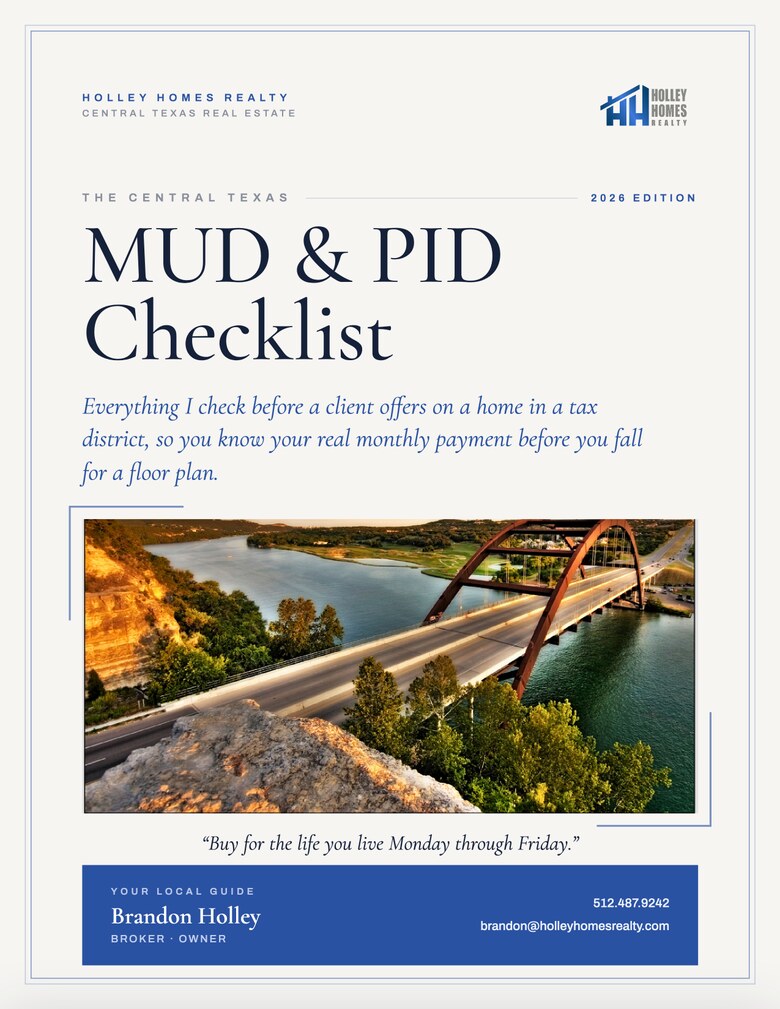
The Central Texas MUD & PID Checklist · Free PDF
A new home's tax district can quietly add $200 to $400 a month.
This is the exact 5-minute check I run before a client offers on any home in a MUD or PID, so you know your real monthly payment before you fall for a floor plan.
✓ Instant PDF
✓ No spam, ever
✓ Works for Austin, Buda, Kyle & Bastrop
Free PDF
The straight answer
MUD vs PID in Texas: what's the difference?
A MUD and a PID are both extra taxing layers you'll find on many new-construction homes around Austin, and they do different jobs. A MUD (Municipal Utility District) charges a tax rate to pay for the water, sewer, and drainage that made the neighborhood possible, and that rate usually falls over time as the district's bonds get paid off. A PID (Public Improvement District) is a fixed assessment that pays for amenities like parks, trails, and landscaping, and it stays flat for a set term, often 20 to 30 years. Neither one shows up on the listing, but both land on your bill.
Side by side
| MUD | PID | |
|---|---|---|
| What it pays for | Water, sewer, and drainage for a new community | Parks, trails, landscaping, lighting, sometimes roads |
| How it hits your bill | A tax rate, charged per $100 of your home's value | A fixed dollar assessment tied to your lot |
| Does the amount change | Yes. It usually drops over the years as bonds are paid down | No. It's fixed for the term (often 20 to 30 years) |
| Can you pay it off early | No, it's a rate, not a balance | Often yes. You can pay off the remaining assessment |
| Do you get a vote | Yes. You elect the board that runs the MUD | No. The city or county sets it up |
| Local examples | Sunfield (Buda), Easton Park (Austin) | 6 Creeks (Kyle), Whisper Valley (Austin) |
The short version: with a MUD, you're taxed on your home's value and the rate can move. With a PID, you owe a set amount you can often pay off.
What a district actually adds: real Central Texas numbers
These are real districts in the markets I work, with the extra a district adds on top of your regular county, city, and school taxes. Rates are for the 2025 tax year and can change, so always confirm the current number for a specific address.
| District | Type | What it adds |
|---|---|---|
| Buda & Kyle (Hays County) | ||
| Sunfield MUD No. 1, Buda | MUD | About $0.87 per $100 of value (the MUD line alone) |
| 6 Creeks PID, Kyle | PID | About $2,979/yr on a 55-ft lot to $4,188/yr on a 70-ft lot, roughly $248 to $349 a month |
| South & Southeast Austin (Travis County) | ||
| Easton Park (Pilot Knob MUD), Austin | MUD | About $0.83 to $0.95 per $100; total tax rate lands around 2.58% to 2.70% |
| Whisper Valley PID, Austin | PID | A fixed assessment of about $914 to $2,933 a year per lot depending on lot type, roughly $76 to $244 a month |
| Bastrop County | ||
| Bastrop County MUD No. 1 | MUD | About $0.6071 per $100 of value |
| West Bastrop Village MUD | MUD | About $1.00 per $100 of value |
For comparison, a typical home in Austin with no district runs a total tax rate around 2.0%. Sources: Hays County and Bastrop CAD 2025 adopted rates, City of Austin 2025 PID service plans, and builder community sheets. Confirm the live number before you write an offer.
How to figure your true monthly cost
Here's the simple math I walk clients through, using a MUD as the example:
Worked example: a $450,000 home in a MUD
Take the home price, divide by 100, then multiply by the MUD rate. Using Sunfield's roughly $0.87 rate:
$450,000 ÷ 100 × 0.87 ≈ $3,915 a yearThat's about $326 a month for the MUD line alone, on top of your regular county, city, and school taxes. A no-district home at the same price simply doesn't have that $326. Over a 30-year loan, that's real money, and it's money that never shows up on the listing.
A PID works differently: you're given a fixed annual assessment (like 6 Creeks' $2,979 to $4,188 a year), so you divide that by 12 to get the monthly number.
Two things that surprise buyers
The homestead exemption still helps in a district. It lowers the taxable value that every rate is applied to, including the MUD, so it shrinks the number the district rate is multiplied by. It doesn't remove the district, but it does soften it. File it the year after you move in.
A brand-new MUD can charge more in its early years. That's because the district is still paying off the bonds that built the water and sewer lines. As those bonds get paid down, the rate usually falls. So the year-one number is often the high point, not a nasty surprise later, as long as you know to expect it.
Watch first
MUD and PID tax, explained in a few minutes
Here's the hidden cost of new homes in Central Texas, walked through start to finish, so you can see how a district lands on your real monthly payment:
What's inside
Everything I check before a client makes an offer
01
MUD vs PID in 30 Seconds
What each district is, who creates it, and exactly how it lands on your bill.
02
The 5-Minute Self-Check
How to find every taxing unit on any address before you ever write an offer.
03
Your True Monthly Cost
A simple formula to turn a tax rate into the real number you'll pay each month.
04
Your Rights
What you're legally owed to be told, and what the district notice actually says.
05
The Year-Two Jump
Why a district payment can climb after you move in, and how to see it coming.
06
The Homestead Exemption
What it actually covers, and how it changes your real monthly number.
07
Central Texas Cheat Sheet
Real district rates side by side across Austin, Buda, Kyle, and Bastrop.
08
Is a District Worth It?
How to decide with clear eyes, and what it means when you go to sell.
The number that never shows up on the listing
The floor plan is on the sign. The tax district isn't.
- ✓A no-district home runs about 2.0% in Austin and roughly 2.4% in Kyle. A district home often runs 2.5% or more, and the highest push past 3.0%.
- ✓On a $450,000 home, that gap is roughly $190 to $400 every month, money that never appears on the listing.
- ✓MUD rates can change year to year, and a brand-new district can even rise before it falls.
- ✓PID assessments are usually fixed for 20 to 30 years, though they can sometimes be paid off early.
- ✓Most buyers don't find out until closing. This checklist means you find out first.
The 30-second version
"Both add to your monthly cost. The difference is who created it, whether the rate can move, whether you can pay it off, and whether you get a vote."
Brandon Holley, on MUD vs. PID
175+
Closed deals
Since 2016
Serving Central Texas
5 min
To check any address
Free
No-obligation checklist

Your local expert
Meet Brandon Holley
Broker / Owner · Holley Homes Realty
I've helped buyers across Austin, Buda, Kyle, and Bastrop since 2016, with 175+ closed deals along the way, and a tax district is one of the very first things I check before a client ever makes an offer.
This checklist is the exact 5-minute process I run, so you can see a MUD or PID's real cost before you fall for a floor plan, not at the closing table.
"My job is to make this feel clear, not complicated. No pressure, just good information so you can decide what's right for you."
Common questions
MUD & PID: quick answers
What is a MUD?+
A Municipal Utility District, created by the state to fund water, sewer, and drainage in a new community. It's charged as a tax rate that can change year to year (it usually drops as the district's bonds are paid down). You vote for the board that runs it. Local examples: Sunfield in Buda and Easton Park in southeast Austin.
What is a PID?+
A Public Improvement District, created by a city or county to fund parks, trails, landscaping, and lighting. It's usually a fixed dollar assessment per lot for a set term, often 20 to 30 years, and can sometimes be paid off early. You don't vote on it. Local examples: 6 Creeks in Kyle and Whisper Valley in east Travis County.
How do I know if a home is in a MUD or PID?+
Check the county appraisal record for every taxing unit on the address, then the county's tax-rate table to see what each one charges. The checklist walks you through the exact 5-minute self-check, step by step, for any address in Austin, Buda, Kyle, or Bastrop.
How much does a MUD or PID add to my payment?+
It varies by district, but on a $450,000 home a district can add roughly $190 to $400 a month versus a no-district home, money that never shows up on the listing. As a real example, the 6 Creeks PID in Kyle runs about $2,979 a year on a 55-ft lot and $4,188 on a 70-ft lot for the 2025 tax year. The checklist gives you a simple formula to work out the real number for any address, and because rates change year to year, always confirm the current figure before you write an offer.
Do MUD or PID taxes ever go away?+
A MUD rate usually declines over time as its bonds are paid off. A PID assessment typically runs for a fixed term (often 20 to 30 years) and can sometimes be paid off early. The checklist also covers what a district means when it's your turn to sell.
Is this checklist really free?+
Yes, completely free and no obligation. Enter your name and email and the PDF is sent to you right away. It's simply the best way I know to be helpful before you ever decide whether to work with me.