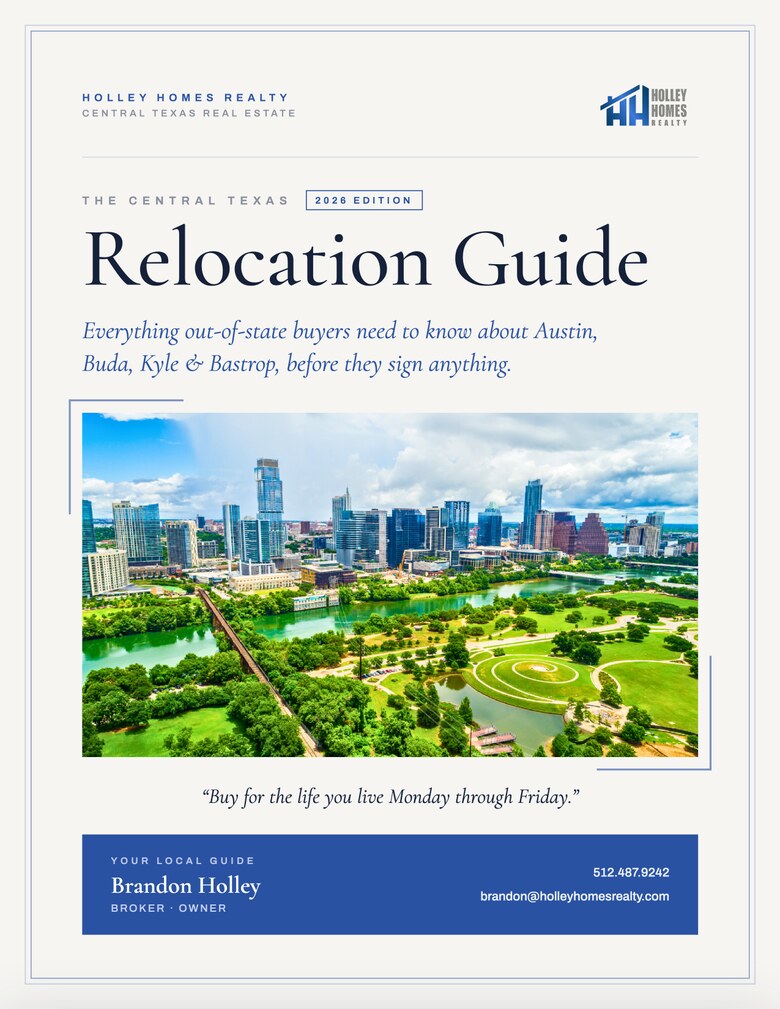
The Central Texas Relocation Guide · Free PDF
Relocating to Central Texas? Compare all four markets first.
Buda, Kyle, Bastrop, or South Austin? My free guide compares all four on price, schools, commute, and taxes, so you pick the right one the first time.
✓ Instant PDF
✓ No spam, ever
✓ FastExpert 2026 Top Agent
Free PDF
The straight answer
Which Central Texas city is right for you?
The real question isn't "Austin?" It's "which part?" These four markets sit within about 30 miles of downtown but live completely differently on the things that decide a move: how far you drive, what your money buys, which schools you're zoned to, and what the taxes really are. Here they are side by side, then a one-line read on who each one fits.
The four markets, side by side
| Market | Drive to Austin | Median (2026) | School district | Tax feel |
|---|---|---|---|---|
| South Austin | In-city, about 15 to 30 min to downtown | About $370K to $575K by ZIP | Mostly Austin ISD (78744 & 78747 split with Del Valle) | About 2.0 to 2.1%, mostly no MUD |
| Buda | About 15 miles, 20 to 25 min on I-35 | About $350K | Hays CISD | City about 1.91%, a MUD like Sunfield pushes toward 2.7% |
| Kyle | About 20 miles, 25 to 35 min on I-35 | About $300K | Hays CISD | About 2.15% combined, plus a PID in 6 Creeks |
| Bastrop | About 30 miles, 35 to 45 min on SH-71 | About $350K | Bastrop ISD | About 1.5% in the county, up to 2.0%+ in a MUD |
Tax rates are before your homestead exemption, and the biggest swing in every one of these markets is whether a specific home sits in a MUD or PID. Always check the exact lot.
The one-line read on each
South Austin
Closest to downtown, with five ZIP codes (78744 to 78749) that each live and price very differently. Best if staying near the city matters most.
Buda
Small-town charm and newer homes with the shortest suburban commute. Best for a walkable downtown feel without going far from Austin.
Kyle
The most home for your money of the four, right on I-35. Best for first-time buyers and growing families who want space and value.
Bastrop
A historic river town in the Lost Pines and the region's fastest-growing corner (the SpaceX corridor). Best for space, character, and jobs nearby.
Beyond the listings
How to choose between four very different places
Zillow shows you prices and Google Maps shows you distances. Neither tells you what your Monday morning will feel like in each of these places, or where the whole region is headed. Here's the honest picture: where Central Texas is growing, how the tax math really works, a simple way to narrow four cities to one, and the checklist for landing here from out of state.
Start with a look at where Central Texas is headed by 2030:
Where Central Texas is growing
The reason all four of these markets are in demand is the same: the jobs and infrastructure keep pushing south and east out of Austin. Knowing where that growth is real (funded and building) versus merely announced is one of the most valuable things I can show a relocation buyer.
- The southeast job corridor. Tesla's Gigafactory in southeast Austin, plus SpaceX, The Boring Company, and X on the SH-21 corridor toward Bastrop, have turned the south and east side into a genuine employment center, not just bedroom suburbs.
- Retail and healthcare catching up. Costco and H-E-B expansions in Kyle, a flagship H-E-B and new schools in Buda, Sprouts and an H-E-B plus! in Bastrop, and new hospital projects in Kyle all point the same direction.
- The roads. TxDOT's I-35 Capital Express work through Austin and the SH-71 corridor rebuild toward Bastrop are the unglamorous projects that decide your commute for the next decade.
How I read the growth for you: a factory expansion backed by a state grant, or a grocer building a flagship store, is real signal. A 400-acre proposal still in feasibility studies is a hope, not a promise. When a sales office uses "coming soon" to justify a price, I check which list it's actually on before you pay for it.
The tax reality most relocation buyers miss
This is the single biggest thing out-of-state buyers get surprised by, and it's the same across all four markets. The list price is not your monthly cost. Newer master-planned communities often sit inside a MUD (Municipal Utility District) or PID (Public Improvement District) that adds a levy on top of the standard county, city, and school rates. On the same-priced home, that difference can run hundreds of dollars a month, and two lots inside the same community can carry different rates by section.
So the "cheaper" home a mile down the road can actually cost more every month once the district is in the math. Before you fall for a floor plan, I pull the certified rate and every overlapping district for the exact lot and show you the real monthly number. My MUD & PID guide walks through exactly how to check any address. One piece of good news for relocators: Texas has no state income tax, which for many buyers from California, Illinois, or the Northeast offsets a good deal of the higher property tax, so run both numbers side by side.
A simple way to narrow four cities to one
Here's the framework I walk through with every relocation client before we tour a single home. Answered honestly, these four questions eliminate most of the confusion:
- What's your real Monday-through-Friday commute limit? Where you work and how far you'll drive quietly rules whole markets in or out. A daily downtown commuter and a fully remote buyer should be looking at different cities.
- What monthly payment are you actually comfortable with? Not list price, the full number with the MUD- or PID-adjusted tax rate, HOA, and insurance. Two homes at the same sticker can be $200 to $300 a month apart.
- New construction or established? New gives you warranty, efficiency, and amenities (often with a district and some construction traffic). Established gives you mature trees, a lower tax rate, and a known neighborhood. Neither is better; they're different trades.
- What's your timeline and who's it for? Chasing a specific school, planting roots for a decade, or expecting to move again in three years all point to different cities and change how much resale should weigh on today's decision.
Go deeper on the market you're leaning toward
Each of these has its own honest, local breakdown, prices, schools, commute, taxes, and what's being built:
Moving to South AustinThe five ZIP-cities, 78744 to 78749
Moving to BudaSmall-town feel, shortest commute
Moving to KyleThe most home for your money
Moving to BastropRiver town, the SpaceX corridor
New to Texas? Your relocation checklist
Whichever city you land in, Texas gives you deadlines. Here they are in the order that saves you a second trip:
- No state income tax. It's constitutionally banned in Texas, so weigh that saving against the higher property tax before you judge either in isolation.
- Register your vehicle within the first month. Get Texas auto insurance first, then visit your county tax office (Hays County in San Marcos for Buda and Kyle, Travis County for South Austin, Bastrop County for Bastrop) with your title and Form 130-U (roughly $145 in fees plus the $90 new-resident tax).
- Get your Texas driver license. Book a DPS appointment online first; walk-ins wait. Bring proof of residency, your closing documents work.
- File your homestead exemption. Free, online, with your county's appraisal district (Hays, Travis, or Bastrop CAD), and prorated from your move-in date, so don't wait for January. Your license address must match the property first, and never pay anyone to file it for you.
- Know the weather. Summers bring 15 to 40-plus days over 100 degrees, winters bring a hard freeze most years (insulate your pipes), and hail is the region's real insurance driver, so a hail-resistant roof can lower your premium.
Vehicle and registration fees, tax rates, prices, and project timelines change; verify current figures before you rely on them.
What's inside
Get oriented across all four cities in one sitting
01
The Central Texas Map
The region at a glance and how the four cities actually connect.
02
The Four Cities Compared
South Austin, Buda, Kyle, and Bastrop side by side, on the things that matter.
03
South Austin
The five ZIP-cities, from 78744 to 78749, each with its own feel and price.
04
Buda, Kyle & Bastrop
What each town is really like to live in, day to day.
05
The Tax Reality
What the "cheaper" home actually costs once tax districts are in the math.
06
New Construction 101
What relocation buyers consistently miss on a brand-new build.
07
Your Decision Framework
A simple way to narrow four cities down to the one that fits you.
08
Your Relocation Checklist
Everything to line up before you make the move.
Four very different places, one region
The right question isn't "Austin?" It's "which part?"
- ✓South Austin, closest to downtown, with five ZIP codes that each live very differently.
- ✓Buda, small-town charm and newer homes just south of the city.
- ✓Kyle, more home for your money without giving up a growing city.
- ✓Bastrop, a historic river town and one of the region's fastest-growing corners.
- ✓Plus the honest tax math on what a "cheaper" home in a district actually costs.
One decision lens to keep with you
"Buy for the life you live Monday through Friday, not the life you imagine on a Saturday morning."
From The Central Texas Relocation Guide
175+
Closed deals
Since 2016
Serving Central Texas
2026
FastExpert Top Agent
Free
No-obligation guide
What clients say
People who trusted the process
★★★★★
"We were relocating on a tight timeline into a brand-new market, and Brandon made it so much more manageable. He pulled together detailed builder payment comparisons and helped us focus on what actually mattered. He felt like someone in our corner the whole time, could not recommend him more!"
M
McKenna Snyder
Relocated to the area · Google review
★★★★★
"Brandon was absolutely amazing throughout our home-buying journey. My husband found him through his YouTube videos, and after watching we knew he was who we wanted. As first-time buyers we had endless questions, and he made everything feel manageable and stress-free. We're now in our first home and couldn't be more grateful."
A
Amber Dopen
First-time buyer · Google review
★★★★★
"From the moment we spotted the 'For Sale' sign on our dream property to closing day, Brandon was incredible. He tackled every challenge with solutions, made sure we understood each step, and always kept things moving. Everyone was aligned to make the deal happen, and they delivered. Highly recommend!"
B
Blake Stowe
Bought his dream home · Google review

Your local expert
Meet Brandon Holley
Broker / Owner · Holley Homes Realty
Since 2016 I've helped buyers and sellers across South Austin, Buda, Kyle, and Bastrop, with 175+ closed deals along the way. I live in South Austin, I went to Texas State down in San Marcos, and FastExpert named me a 2026 Top Agent for Bastrop. Four markets is a deliberate limit. It is how many I can know well enough to give you a real opinion instead of a guess.
This guide is everything I would tell you if you were sitting across from me, trying to work out where in Central Texas you actually belong.
"My job is to make this feel clear, not complicated. No pressure, just good information so you can decide what's right for you."
Common questions
Moving to Central Texas: quick answers
Which Central Texas city is right for me?+
It comes down to your commute, budget, and lifestyle. South Austin is closest to downtown; Buda and Kyle offer more space and value south of the city; and Bastrop is a historic river town that's growing fast. The guide compares all four side by side so you can narrow it down.
How far are Buda, Kyle, and Bastrop from Austin?+
Roughly 15 miles to Buda and about 20 miles to Kyle down I-35, and around 30 miles to Bastrop via SH-71, generally a 20 to 45 minute drive depending on where you're headed and traffic. The guide gives honest, real-world commute times.
Is it cheaper to live outside Austin?+
Often, but not always once you factor in tax districts (MUDs and PIDs) on new construction. The guide shows what a "cheaper" home actually costs once everything's included, so you're comparing real monthly numbers.
Which Central Texas suburb has the most home for the money?+
Of these four markets, Kyle is generally the value leader, with a median around $300,000 as of 2026, the lowest of the group. Bastrop and Buda sit a step up around $350,000, and South Austin is the priciest because it's closest to downtown. In every case the tax district matters as much as the sticker price, so compare the full monthly number.
Which area is growing the fastest?+
Bastrop is the standout right now, driven by the SpaceX, Boring Company, and X campuses on the SH-21 corridor and a wave of new retail and roads. Kyle and the southeast Austin corridor near Tesla are close behind. Fast growth is good for long-term demand, but it also means construction traffic and shifting school boundaries, which the guide helps you weigh.
What should out-of-state buyers know before buying new construction?+
The guide's New Construction 101 covers what relocation buyers consistently miss, including tax districts, build timelines, and builder incentives, so you go in with clear eyes.
What school districts serve these areas?+
It varies by city and address: Hays CISD serves Buda and Kyle, Bastrop ISD serves Bastrop, and South Austin is a mix of Austin ISD, Del Valle ISD, and Hays CISD depending on the ZIP. The guide breaks it down.
How do MUD and PID tax districts work here?+
A MUD or PID is an extra tax levy layered on top of the standard county, city, and school rates, usually to fund the roads, water, and amenities in a newer community. It can add hundreds of dollars a month on the same-priced home, and even two lots in the same community can differ by section. It's not a dealbreaker, but you should always check the exact lot before you offer. My MUD and PID guide shows exactly how.
Is this guide really free?+
Yes, completely free and no obligation. Enter your name and email and the PDF is sent to you right away. It's simply the best way I know to be helpful before you ever decide whether to work with me.