The Complete New Construction Guide · Free PDF
Building a new home in Central Texas?
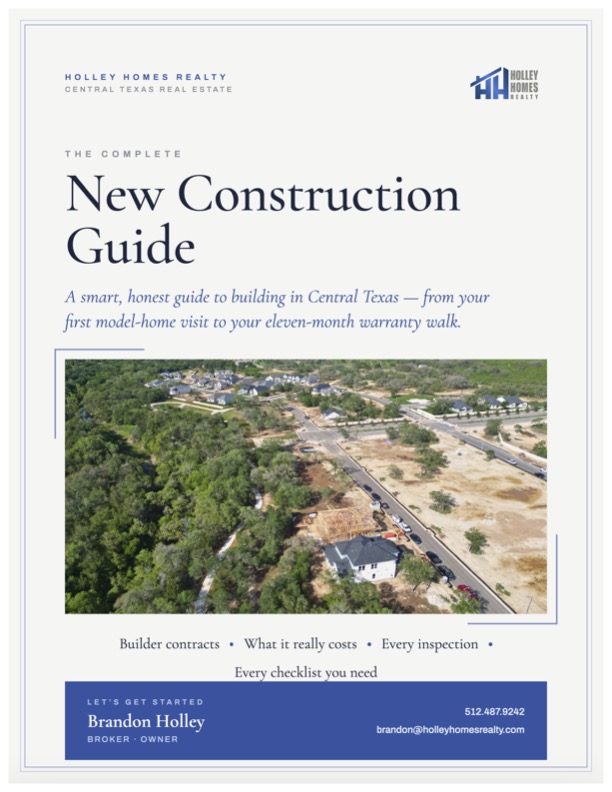
A smart, honest guide to building, from your first model-home visit to your eleven-month warranty walk. The builder is not your agent, the base price is not your real cost, and the year-two tax jump catches almost everyone. Here is how to build with clear eyes. No pressure, just a plan.
✓ Instant PDF
✓ No spam, ever
✓ 175+ closed deals since 2016
 Free PDF
The straight answer
How does building a new home in Central Texas work?
Building follows a long timeline with a handful of moments that decide everything: who represents you, which builder and lot you choose, what the contract says, and the two inspections you schedule. New does not mean risk-free, it means the risks are different. Loop in your own agent before your first model-home visit (it usually costs you nothing), get a pre-drywall and an eleven-month inspection, and budget against your year-two payment, not your first one. Most Central Texas production builds run seven to eleven months from contract to keys. Here is the honest version of what it takes, then the full walk-through below.
Building in Central Texas at a glance
- ✓The builder is not your agent: the sales rep represents the builder. Bring your own representation from the first visit, usually at no cost to you.
- ✓The base price is not the cost: as of 2026 the base is often around 85% of what you actually spend once upgrades, blinds, fencing, and landscaping are in.
- ✓The year-two tax jump: Texas taxes your home as a vacant lot the first year, so your payment can rise meaningfully in month thirteen. Budget against the finished-value number.
- ✓A new home still needs its own inspection: pre-drywall and again around month ten or eleven, before your workmanship warranty runs out.
- ✓Check the tax district: many new communities sit in a MUD or PID (sometimes both, plus an HOA). Get the full annual number before you sign, not the rate in isolation.
Every dollar figure here is a 2026 illustration, not a quote. Your Loan Estimate is the real number, and you get one within three business days of applying. For the statewide buying process, see my Central Texas buyer's guide.
What's inside
The build, decoded, from model home to warranty walk
01
Representation
Why the builder's rep works for the builder, and how to keep your options open from the first visit.
02
Builder, Lot & Plan
Production vs custom, how to evaluate a builder in a state that doesn't license them, and why the lot is the one thing you can't change.
03
The Contract
You're signing the builder's contract, not the standard form. What's normal, what to question, and when to bring in an attorney.
04
The Money
Incentives, the design center, what a build actually costs, and the year-two tax jump nobody warns you about.
05
The Build Timeline
Contract to keys in fourteen phases, and the short pre-drywall window that never reopens.
06
Inspections
Why a brand-new home still needs its own inspector, at pre-drywall and again before the warranty ends.
07
Walkthrough & Closing
The punch list, the appraisal timing gap, your rate lock, and how to never lose your down payment to wire fraud.
08
Warranty & Year One
The 1-2-10 warranty decoded, and why month eleven is your last free repair.
Watch first
New construction vs resale: which home wins?
A few honest minutes on how new construction and resale really compare once you're living in the house, and how to pick the right one for your situation.
Before you sign
The decisions that matter most happen before groundbreaking
The builder is not your agent
Builder sales reps are helpful, but they represent the builder. If you visit a community on your own, the builder may require you to work directly with their sales team, which can limit your ability to bring your own representation later. Most builders ask that your agent be present and registered on your first visit, not the second, the first. It takes one text before you walk in. In most Central Texas communities the builder offers compensation to your agent, so representation typically costs you nothing out of pocket, though it varies by builder and we confirm it in writing before you are committed to anything. The model home is beautiful. The contract behind it deserves a second set of eyes.
New construction vs resale
Most people who write this comparison only sell one of the two. I sell both. A resale home in an established Buda or Kyle neighborhood usually sits on a larger lot, with mature trees, ten minutes closer to everything, and a tax bill you can look up before you offer. A new build gives you a house nobody has broken, systems nobody has neglected, and a warranty. You are choosing between a known house in a settled place and an unknown house in a place that is not finished yet. Both are reasonable. If the resale two miles away is the better house at the better number, I will say so, and I would rather say it before you have picked out countertops.
Builder, lot, and plan
Texas does not license homebuilders, so evaluating one is your job and mine: reputation, warranty performance, and the evidence of their older communities are what you have. For my honest, first-hand tier list of the builders I have worked with across these markets, see my Central Texas builder guide. Ask the rep how they would handle a warranty issue in month ten. A rep who names a process and a person is describing a builder with a real warranty department. And choose the lot carefully, because you can change almost everything about a house later but never where it sits. Lot premiums run from a few thousand dollars into five figures, and "that will always be open space" is the most common thing a buyer is told that turns out not to be true. Get it in writing, or price the lot as if a future phase will build on it.
The money
The base price is the beginning of the conversation, not the end
What a new build actually costs
A builder will tell you the price. Your job is to find out the cost. As of 2026, on a typical Central Texas production build the base price is often around 85% of what you actually spend. The rest is the design center, your cash to close, and the first six months: blinds, fencing, gutters, landscaping, and appliances are not in the base price and are not financed, and they can run into five figures right after you have spent everything at closing. At the design center you will make dozens of decisions in an afternoon, most rolled straight into your loan. Buy everything structural or behind drywall, then ask of every finish: will the next buyer pay me back for this? Upgrade to the top of the community, not past it.
The year-two tax jump
This is the one that catches nearly every new-construction buyer in Central Texas, and it is not a mistake, it is how appraisal works. Texas assesses property as of January 1. If your home was not finished that day, the county assessed the lot, not the house, and your lender built your first-year escrow on that land bill. The next January the county assesses a completed home, your escrow recalculates, and it also has to make up what it under-collected. Both land in the same month, so your payment can jump substantially in year two, sometimes a few hundred dollars a month. The fix is one conversation at contract: ask your lender to estimate your escrow on the finished value, not the current land assessment. If they cannot, set the difference aside yourself every month. Knowing it is coming is the whole trick.
MUD, PID, and the tax district
Many Central Texas new-construction communities sit inside a Municipal Utility District or a Public Improvement District, which adds to your tax rate or your annual bill, sometimes meaningfully. Some have both, plus an HOA on top. As of 2026, moving the same home from a community at roughly 2.18% into one near 2.75% can add on the order of $200 a month, money that appears nowhere on the listing and rarely comes up at the sales office. That is not a reason to avoid these communities, many buyers decide the amenities and schools are worth every dollar. It is a reason to get the total annual number before you sign, not the rate in isolation. My MUD and PID guide walks through exactly what to ask and where to verify it.
Your path
How the build actually goes
01
Contract and design center
You lock your price and plan, then make your selections. Set your upgrade budget before you walk in and bring someone who will hold you to it.
02
Permits and slab
Plans are finalized, the city authorizes the build, the lot is staked, and the foundation is poured and left to cure.
03
Framing and rough-in
Walls and roof go up, then electrical, plumbing, and HVAC run inside the walls. This is what your inspector most needs to see.
04
Pre-drywall inspection
Your independent inspection belongs here, and the window is short, sometimes days. Once insulation and drywall go in, it is behind a wall for good.
05
Finishes and systems
Cabinets, counters, trim, paint, and flooring go in, systems are tested, and the city issues the Certificate of Occupancy.
06
Walkthrough and closing
You walk the home, build the punch list in writing, confirm the appraisal and your rate lock held, and close. Keys are the middle of the story, not the end.
Most Central Texas production builds run seven to eleven months, custom runs twelve to eighteen. Ask your builder for their actual average in this community, not the brochure number.
Protect the purchase
Inspections, the walkthrough, and the closing table
Why a new home still needs its own inspection
The city inspected it and the builder walked it, but none of those inspections were for you. A brand-new home has never been tested by a summer, a hard rain, or a full August of HVAC, and it was built fast by many crews under schedule pressure. Builder and city inspections protect the builder and code compliance. An independent inspection protects you. Most buyers do two, pre-drywall and final, at a few hundred dollars each. A pre-drywall report on a Central Texas production home typically lists two to four dozen small items, and nearly every one is corrected free, within a week, by the crew already on site. The same items found after closing are yours to chase, and the ones behind drywall are yours to pay for. The point is not to catch the builder, it is to hand them a list while fixing it is still their job.
The eleven-month warranty inspection
Most builder workmanship warranties run one year from closing. If you inspect at month twelve, you have found problems you no longer have coverage for. Inspecting at month ten or eleven gives you a written report, time to submit it, and weeks of runway for the builder to respond while they are still obligated to. Put it on your calendar the day you close. It costs a few hundred dollars and it is the last free repair you will ever get on this house, and it is the single most commonly missed step in new construction.
Two things that behave differently at closing
First, the appraisal happens near completion, sometimes eight or ten months after you locked your price at contract. If the market moved down in between, the appraisal can come in under your contract price, and how that is handled depends entirely on what your builder contract says. Know that answer before you are in it, and ask your lender at contract about an extended rate lock. Second, protect your money: real estate wire fraud is the most common way buyers lose their entire down payment. Never take wiring instructions from an email, not from me, not from the title company. Call a number you looked up independently and verbally confirm every digit before you send a dollar.
175+
Closed deals since 2016
1-2-10
Warranty, decoded inside
4
Markets I build in
Free
No-obligation guide
What clients say
People who trusted the process
★★★★★
"As first-time homebuyers deciding on a new build, we're so fortunate to have had Brandon. He always knew what to ask the builder, even when we had no idea what to ask, checked in regularly, and handled all the details so we felt supported the whole way. Can't recommend him highly enough!"
M
Megan McLane
New-build buyer · Google review
★★★★★
"My wife and I bought a new home, and every step with Brandon was first class. We were on a tight deadline while also selling our home in east Texas, and he stayed steady and calm and made sure everything lined up so we closed on schedule. He genuinely cares, my highest recommendation."
G
Greg Moore
New-build buyer · Google review
★★★★★
"Brandon was absolutely amazing throughout our home-buying journey. My husband found him through his YouTube videos, and after watching we knew he was who we wanted. As first-time buyers we had endless questions, and he made everything feel manageable and stress-free."
A
Amber Dopen
First-time buyer · Google review

Your local expert
Meet Brandon Holley
Broker / Owner · Holley Homes Realty
New construction is a market I know deeply. With 175+ closed deals since 2016 across Austin, Buda, Kyle, and Bastrop, and named a FastExpert 2026 Top Agent, I've walked buyers through builder contracts, design centers, pre-drywall inspections, and eleven-month warranty walks in every one of these markets. I represent you, not the builder, and in most communities that costs you nothing out of pocket.
This guide is everything I'd tell you across a table before you sign a builder contract, including the parts a sales office has no reason to bring up.
"My job is to make this feel clear, not complicated. No pressure, just good information so you can decide what's right for you."
Explore by market
Where to go next
Building in a specific town? Each market has its own new-construction guide: Buda, Kyle, Bastrop, Central Texas, and South Austin. Ready to see specific communities? Browse every new-construction community I have toured, or size up the builders in my Central Texas builder guide. Before you compare monthly costs on any community, read the MUD and PID guide. And for the full statewide buying process from pre-approval to keys, the Central Texas buyer's guide has every step.
Common questions
Building new construction: quick answers
Do I need my own agent for new construction?+
Yes. The builder's sales rep is helpful but represents the builder, not you. Bring your own representation, and register it, on your very first visit to a community, because visiting alone can limit your ability to have your own agent later. In most Central Texas communities the builder compensates your agent, so representation typically costs you nothing out of pocket. I confirm that in writing before you're committed to anything.
Why did my payment jump in year two on a new build?+
Texas assesses property as of January 1. If your home wasn't finished that day, the county assessed the vacant lot, and your lender built your first-year escrow on that land bill. The next January it assesses a finished home and your escrow recalculates and makes up the shortfall, so your payment can rise substantially in month thirteen, sometimes a few hundred dollars a month. It's not a mistake. Ask your lender at contract to estimate escrow on the finished value, or set the difference aside yourself, and the jump becomes a non-event.
What does a new build actually cost beyond the base price?+
As of 2026, the base price is often around 85% of what you'll actually spend on a typical Central Texas production build. The rest is the design center (structural upgrades, finishes), your cash to close, and the first six months of things that aren't financed: blinds, fencing, gutters, landscaping, and appliances, which can run into five figures. A builder tells you the price; the job is to find out the cost. Every number here is a 2026 illustration, your Loan Estimate is the real one.
Does a brand-new home really need an inspection?+
Yes. The city and the builder inspected it, but not for you, and a new home has never been tested by a summer, a hard rain, or a full August of use. Most buyers get two independent inspections, pre-drywall and final, at a few hundred dollars each. A pre-drywall report typically lists two to four dozen small items, nearly all corrected free by the crew on site, while the same items found after closing are yours to chase or pay for. It's the cheapest insurance in the transaction.
How long does it take to build a home in Central Texas?+
Most Central Texas production builds run seven to eleven months from contract to keys. Custom builds run twelve to eighteen. Timelines are estimates, not guarantees, so ask your builder for their actual recent average in that specific community, not the brochure number, and build slack into your plans if you have a lease ending or kids starting school on a fixed date.
What is a MUD or PID, and how does it affect a new build?+
A MUD (Municipal Utility District) or PID (Public Improvement District) is a special district that finances a community's infrastructure and adds to your tax rate or annual bill. Many new Central Texas communities sit in one, some in both, plus an HOA. As of 2026, the same home in a higher-rate community can cost roughly $200 a month more, money that never shows on the listing. Get the total annual number before you sign. My MUD and PID guide shows exactly how to check.
Production, semi-custom, or custom builder, what's the difference?+
Production builders offer a fixed set of plans with a shorter, more predictable move-in and price. Custom builders let you shape nearly every detail but take longer and cost more. Most Central Texas buyers land in between, with a semi-custom builder: fixed floor plans, but real structural options and a wider finish palette. If production feels too rigid and custom feels like a second job, that's the lane to look in.
How does a builder warranty work?+
Most production builders offer a version of what's called a 1-2-10: roughly one year on workmanship (paint, drywall, trim, the widest and shortest coverage), two years on the systems (plumbing, electrical, HVAC), and ten years on major structural elements. It's an industry convention, not a Texas law, and the specifics vary by builder, so read yours. The takeaway: document everything in writing from day one, and use that eleven-month inspection while the workmanship coverage is still live.
Is this guide really free?+
Yes, completely free and no obligation. Enter your name and email and the PDF is sent to you right away. It's simply the best way I know to be helpful before you ever decide whether to work with me.